On this page
Cost · 9 min read ·
Polished Concrete vs Microcement: Thickness, Cost, Cracks and Where Each Wins

Two finishes get called the same thing, and from a photograph they can look identical: a smooth, mineral, concrete-grey floor with a soft sheen. They are not the same job. Polished concrete is the structural slab itself, ground and polished in place; microcement is a thin coating laid over whatever floor is already there.
The plain answer: polished concrete is a poured slab about 100 mm thick that needs a new-build slab or a ground floor that can take the weight, and it cures for around 28 days before polishing. Microcement is a 2–3 mm overlay over an existing sound floor, so it works in a first-floor flat or a renovation where a slab is impossible. On cost, polished concrete runs £100–£150/m² on large areas, microcement floors £120–£200/m² in our cost guide.
What each one actually is
Polished concrete is the concrete floor slab itself — the structural pour that carries the building — ground, honed and polished with bonded diamond abrasives until the surface takes a sheen. A densifier is worked into the surface to harden it; the shine comes from refining the slab, not from a film on top. Wikipedia’s entry on polished concrete describes it as a concrete floor ground, honed and polished with bonded abrasives to reach a chosen level of gloss.
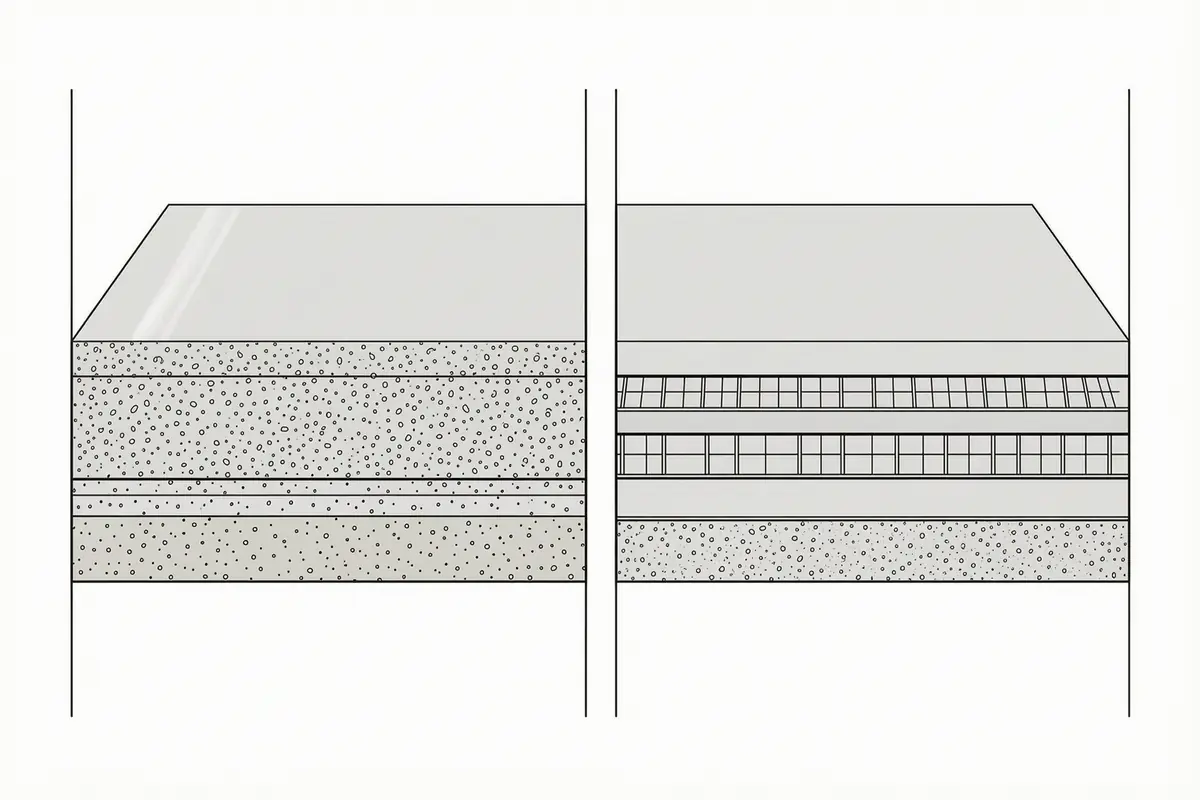
Microcement is the opposite: a cement–polymer coating applied by hand in thin layers over a primer and a fibreglass mesh, then colour coats and a polyurethane sealer, to a total of about 2–3 mm. It is a finish, not a structure — only ever as stable as the floor it is bonded to. One is the building, the other a skin over it.
Thickness: a slab versus a 3 mm overlay
The build height is where the two part company in practice. A polished concrete floor is a structural slab, typically around 100 mm thick and reinforced, poured as part of the building. Microcement adds about 2–3 mm on top of the floor that already exists. A 2–3 mm overlay does not raise a floor enough to touch doors, thresholds, skirting or stair nosings, so a renovation keeps its existing levels. A 100 mm slab changes the finished floor level by a full brick course and has to be designed in from the start — a structural decision, not a decorative one. Where the slab is already there, polished concrete uses it; where it is not, the slab is the cost and the obstacle, and the overlay is the way to the same look.
What each needs from the building
Polished concrete needs a slab to polish. In a new build or a ground-floor extension that slab is poured anyway, so polishing it is a finish on top of structure that was going in regardless. In an existing home there is usually no slab, and casting one means digging out the floor, pouring and reinforcing 100 mm of concrete, and waiting for it to cure. On a first-floor flat that is close to impossible — a suspended timber or beam-and-block floor is not a slab, and the structure was never designed to carry one.
Microcement needs far less. It bonds to a sound, stable substrate — cured screed, existing tiles, overboarded timber, or prepared concrete — which is why it suits London flats, Victorian terraces and mansion-block conversions where there is no slab and no prospect of one. The question the building answers is simple: is there a structural slab to polish, or is there a floor to overlay? Most renovations are the second.
Cost: the two bands
The headline rates are closer than the build-height gap suggests, but they buy different things. Polished concrete’s £100–£150/m² assumes the slab already exists — it is the grinding, densifying and polishing of concrete that is there. Microcement flooring sits at £120–£200/m² in our cost guide, full system, over the floor that is already down. Walls run £100–£180/m², and a bathroom walls-and-floor system £140–£220/m² with the wet-zone sealer.
| Finish | Thickness | £/m² | Needs a slab? |
|---|---|---|---|
| Polished concrete | ~100 mm structural slab | £100–£150 on large areas | Yes — ground and polished in place |
| Microcement floor | 2–3 mm overlay | £120–£200 | No — goes over the existing floor |
The honest comparison is not rate against rate. Polished concrete looks cheaper until you add the slab it depends on; microcement looks dearer until you notice it needs no slab or dig-out. On a new-build slab the polished route is often cheaper; on an existing floor the overlay is the only route that does not start with a digger. The floor-specific numbers sit in our microcement floor cost guide.
Cracks and movement
Concrete cracks — it is the one thing everyone knows about it, and it is true. As Wikipedia’s entry on polished concrete puts it, normally all concrete floors have cracks; the cracks, pinholes and micropits are grouted and patch-filled before polishing proceeds. A polished floor manages movement by deciding where it happens: saw-cut control joints are cut into the slab, typically every 4 to 5 metres, so shrinkage cracks run along a straight, chosen line rather than wandering across the floor. The result is a floor honest about its joints — you see them, and they are part of the design.
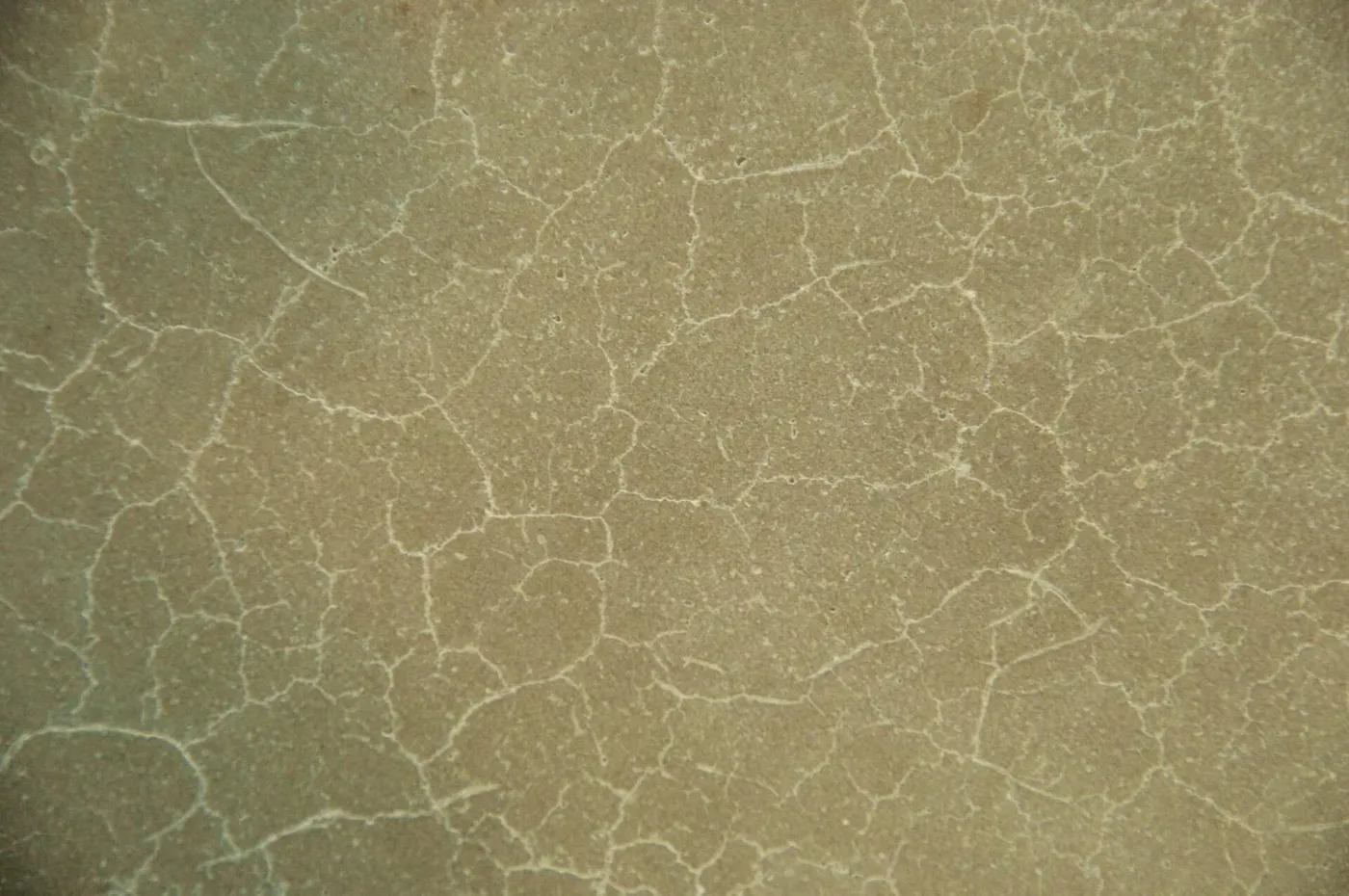
Photo: Hairline cracks by Prygpt, CC BY-SA 4.0 via Wikimedia Commons; resized.
Microcement takes the opposite approach. Because it is only 2–3 mm thick, it cannot absorb movement on its own, so it is laid over a fibreglass mesh that spreads any residual movement across the surface instead of letting it concentrate into one crack. It still relies on the substrate being stable — a floor that is still moving will crack the overlay the same way it would crack a slab, and the failures we are asked to repair are almost always a substrate problem, not a material one. The difference is where the movement is handled: in polished concrete it is designed into the slab with joints; in microcement it is neutralised in the substrate and the mesh before a coat goes on.
Programme and disruption
Polished concrete is slow because the concrete is slow. A new slab is cured with water for seven days, and polishing should not begin until it is fully cured — generally around 28 days — before the grinding, densifying and polishing sequence starts. The surface also has to be hard enough to grind, with a densifier bringing it to roughly 32–40 MPa before the abrasives can work. That is a structural timescale, not a decorating one.
Microcement is measured in days, not weeks. The overlay goes down coat by coat over the existing floor, and a room is typically back in use within a working week rather than a month. The trade-off is honest: polished concrete is the slower, heavier, more permanent option, and microcement is the faster, lighter one. When a renovation cannot wait a month for a floor to cure, that alone usually settles the choice.
Where each one wins
The decision comes down to the building, not the look:
- New build or extension with a slab — polished concrete, if the slab is being poured anyway and the programme can absorb the cure.
- Existing home, any floor — microcement over what is there; no dig-out, no slab, no level change.
- First-floor flat or suspended floor — microcement, because there is no slab to polish and the structure will not take one.
- Ground floor where a slab exists but is rough or cracked — polish it if it is sound enough to grind; overlay it with microcement if it is not.
- Wet rooms and bathrooms — microcement, sealed with a wet-zone sealer, which is where our microcement in bathrooms post picks up.
- Underfloor heating — microcement works over a commissioned, cycled UFH system, and polished concrete can sit over UFH too; sources disagree on which is safer, so have the screed and heating commissioned and tested before any finish goes down. Our underfloor heating guide covers the microcement side.
Most of the homes we work in across London and Surrey fall into the middle rows: existing floors, no slab, no appetite for a month of curing. That is why microcement is the finish we lay most often — not because it is better, but because it is the one the building will allow.
”Micro concrete” — the term people use for both
One thing worth clearing up: “micro concrete” is not a third material. It is a loose term people use for both finishes, usually meaning the thin, seamless, concrete-look surface rather than a structural pour. When someone says they want a “micro concrete floor”, they almost always mean a microcement overlay — the 2–3 mm coating — because that is the product that delivers the look in an existing home. Polished concrete is the slab; microcement is the overlay; “micro concrete” is the phrase that blurs the two. If a quote uses the term, ask which one it means, because the price and the programme are nothing alike.
Frequently asked questions
Do polished concrete and microcement look the same?
Close, but not identical. Polished concrete shows the slab’s own aggregate and is graded by sheen, from matte to high gloss, with colour coming from dyes or stains worked into the slab. Microcement is a trowelled finish with controlled colour and texture, sealed matt, satin or gloss, and a wider colour range mixed into the coat itself. From across a room they read as the same idea; up close the polished slab shows stone, and the overlay shows the hand of the trowel.
Can I have polished concrete in a flat?
Rarely. Polished concrete needs a structural slab to grind, and a first-floor flat sits on a suspended floor, not a slab. Casting a 100 mm slab where none exists is a structural job most flats cannot take. The concrete look in a flat is microcement over the existing floor.
Which is cheaper?
It depends on the slab. On a new-build slab that is poured anyway, polishing it at £100–£150/m² is usually cheaper than overlaying. In an existing home with no slab, microcement at £120–£200/m² is the whole cost, where polished concrete would first need a slab poured. Compare the total, not the rate.
Which cracks less?
Both crack if the structure moves. Polished concrete manages movement with saw-cut control joints so cracks run where chosen. Microcement relies on a stable substrate and a fibreglass mesh to spread movement. Neither is crack-proof; both fail when the floor underneath them is still moving.
How long does each last?
Polished concrete is the slab itself, so it usually lasts far longer than the finish on top of it. Microcement is a coating, and while it can last ten years or more on a stable floor, it will need refinishing sooner than a polished slab will — a microcement overlay can be refinished many times, where a polished slab can only be re-polished a few times before the surface thins.
How long does each take?
Polished concrete waits for the slab: seven days of water curing, then polishing only after roughly 28 days of full cure. Microcement is laid coat by coat and is typically back in use within a week or so. The slab’s cure, not the polishing, is the long wait.
Which should I choose?
Start with the building. A slab to polish means polished concrete is on the table; an existing floor with no slab means microcement is the realistic route. After that it is colour, sheen and programme. For the concrete look in an existing London home, microcement is usually the answer — see our microcement flooring page for the system.