On this page
Design · 9 min read
Microcement bathroom ideas: colours, finishes and 9 looks that work
Pinterest will happily show you three hundred microcement bathrooms; what it won't tell you is which of them survive contact with a real London floor plan, a real light level, and a real cleaning routine. These are the colour schemes and design moves we actually install — what each one needs to work, and where it goes wrong.
Colours that actually work in bathrooms
Our palette runs to 40+ standard colours (browse them under colours & styles), but bathrooms cluster around five families:
- Warm beige and greige — the runaway favourite. Tones like Deer, Malta and Harewood read as soft stone rather than concrete, flatter warm lighting, and are the most forgiving of hard-water marks. If you want a bathroom that still looks calm five years in with normal cleaning, start here.
- Soft white and bone — Stucco White and its neighbours. Brighter and more gallery-like than beige, and the best choice for boxy rooms with a single small window. Pure brilliant white doesn't exist in microcement the way it does in paint — the material always keeps a mineral softness, which is exactly why it doesn't feel clinical.
- Concrete greys — Concrete, Galaxy, Selenita. The classic "polished concrete" look. Mid-greys are the sweet spot; very pale greys can read cold under cool LEDs, so we always sample against your actual lighting before committing.
- Muted greens and earth tones — sage and olive schemes have grown fast in the last two years. They pair beautifully with oak vanities and brushed brass, and hide toothpaste sins better than anything pale.
- Charcoal and near-black — Blackboard, Obsidiana, Stormy Night. Dramatic and hotel-like, best in en-suites and cloakrooms where the compression feels intentional. Two honest warnings: dark tones show limescale spotting in hard-water areas (London is one), and they want generous lighting design to avoid gloom.
Whatever the family, ask for sample boards in your room, viewed morning and evening. Microcement is hand-applied and subtly clouded; a 10 cm swatch online tells you the pigment, not the finish.
Nine looks from real projects
- The full wrap — one colour, floor to walls to ceiling, shower included. The purest version of the material and the one that makes small rooms feel biggest. Works best in smooth or light stucco finish.
- The wet-room monolith — open shower, no screen or a single fixed panel, floor falling to a linear drain, walls and floor continuous. The flagship microcement bathroom; budget implications in the bathroom cost guide.
- The floating vanity — a microcement-formed vanity cantilevered off the wall, basin integrated in the same material. No joints, no silicone line around a drop-in basin, one sculptural object.
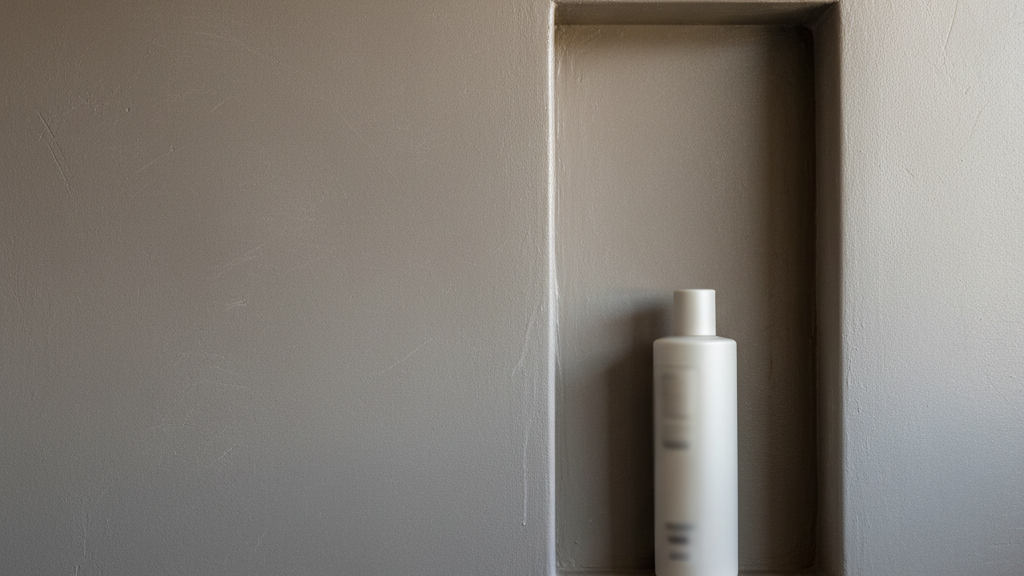
- The formed niche — shampoo niches and recessed shelves rendered in the same finish as the wall, sometimes a shade darker for depth. Tile needs trims and cut edges here; microcement just continues.
- The curved corner — radiused wall junctions and curved partition walls instead of square corners. Softens hard little rooms remarkably, and it's a detail only a trowelled finish does cleanly.
- Tone-on-tone zoning — the same colour family two shades apart: pale walls, deeper floor and shower zone. Reads as intentional design rather than contrast for its own sake, and grounds the room.
- The tiled accent strip — microcement envelope with one band of zellige or patterned tile behind the basin. The hybrid covered in microcement vs tiles: pattern where it's dry and easy to clean, seamless everywhere water hits.
- The integrated bench — a formed seat in the shower zone, same material as everything else. Spa-like, practical, and a detail that costs days of crafting time — see what drives the price in the cost breakdown.
- The bath plinth — a freestanding bath on a low microcement platform, floor continuing up the step. Turns the bath into a centrepiece without a single tile edge.
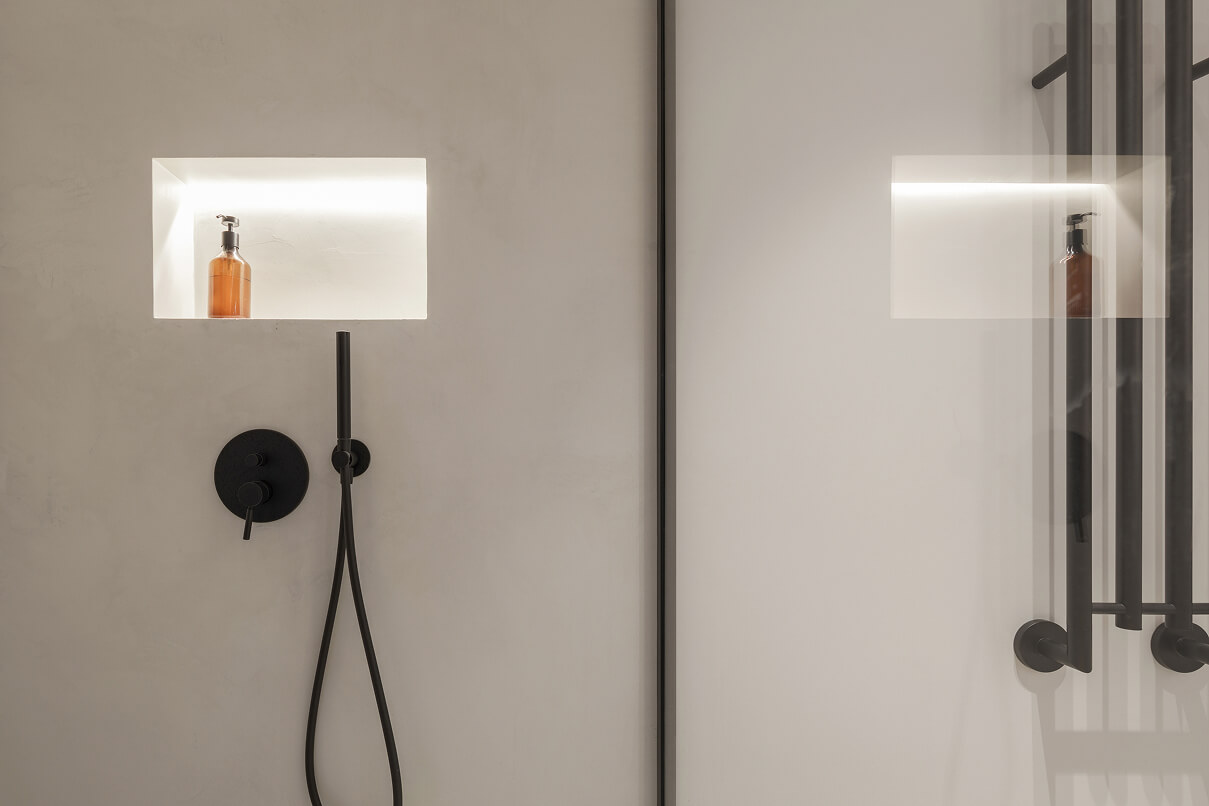
Small bathrooms and en-suites
Microcement's strongest optical trick is subtraction: no grout grid means nothing measuring the room against you. In a 3–4 m² en-suite we lean on four moves: one colour everywhere including the ceiling if it's sound; light, warm tones (the beige and bone families) rather than dramatic darks; a wall-hung WC and floating vanity so the floor runs uninterrupted to the wall; and a niche instead of shelves, because anything that projects shrinks the room. A compact en-suite in full microcement runs £4,500–£8,000 — the size-by-size bands are in the bathroom cost guide.
Smooth, stucco or coarse?
The same colour reads differently depending on the trowel finish:
- Smooth — minimal movement, the most contemporary read, and the easiest to clean; the default for wet zones and small rooms.
- Stucco — soft clouding and gentle trowel marks; the "hand-made" look most people picture when they imagine microcement. Forgiving of daily marks.
- Coarse — pronounced texture for feature walls; we generally keep it out of splash zones because texture holds water droplets and product residue.
Finish also changes maintenance behaviour slightly — texture hides watermarks but holds soap film longer. The daily-life detail is in microcement in bathrooms, and the waterproofing behind all of it in is microcement waterproof?
What to pair it with
Microcement is a quiet background, which is why it pairs so well with one or two strong companions: oak and walnut vanities (warmth against mineral), brushed brass or bronze brassware on beige and green schemes, matt black fittings on grey and charcoal schemes, linen and boucle textiles to stop echo-y minimalism, and large-format mirrors which double the seamless effect. The one pairing we counsel against: high-gloss tile floors meeting matt microcement walls — the sheen clash cheapens both.
Putting a budget on an idea
Ideas are free; formed benches are not. As a rule of thumb from the looks above: colour choices cost nothing, tone-on-tone zoning adds a little masking time, and every formed element — niche, bench, vanity, plinth, curve — adds 1–2 days of crafting. A moodboard-heavy spec typically lands 25–40% above the plain-room base. The full arithmetic is in the microcement bathroom cost guide, and real finished rooms are in the gallery — usually the fastest way to turn "something like this" into a quotable spec.